
Unlocking Genetic Potential — The Foundation of Livestock Transformation
Sustainable and large-scale livestock transformation in Ethiopia begins, fundamentally, with superior genetics. The productive ceiling of any livestock enterprise, whether a smallholder dairy farm on the Ethiopian highlands or a commercial beef operation in the lowlands, is determined first and foremost by the genetic potential of the animals being managed. Feed, management, and health inputs can only fully deliver their value when the underlying genetics are capable of responding to them. This is why Breed Improvement is LDI’s oldest, most established, and most strategically central service area.
LDI’s Breed Improvement programs serve every type of livestock producer in Ethiopia, from smallholder farmers with one or two cows to large commercial operations managing hundreds of animals, from highland dairy producers to pastoral camel herders. Our approach integrates world-class genetic resources with practical field delivery systems, expert advisory support, and data-driven monitoring to ensure that genetic improvement translates into real productivity gains on the ground.
Services currently cover cattle comprehensively, with systematic expansion to small ruminants (sheep and goats), poultry, and camelids underway as part of LDI’s five-year expansion program.
National Artificial Insemination (AI) Program
The National AI Program is the backbone of Ethiopia’s livestock genetic improvement effort and LDI’s most widely accessed service. By providing nationwide access to superior genetics through artificial insemination, the program enables every farmer in Ethiopia, regardless of location, farm size, or income level, to benefit from the same elite genetic material that drives productivity in the world’s most competitive dairy and beef industries.
Artificial insemination replaces the traditional practice of natural service by local bulls with precisely controlled insemination using frozen semen from carefully selected, high-performance bulls of globally recognized elite breeds. The result is dramatically improved offspring — calves that grow faster, produce more milk, have better disease resistance, and convert feed more efficiently than their local-breed parents. Over successive generations, this genetic improvement compounds, creating herds and flocks with fundamentally transformed productive capacity.
What the AI Program Provides
- National AI Center and Station Directory: A comprehensive, interactive digital map and searchable directory of every AI center, sub-center, and satellite station operating across Ethiopia. Each listing includes: center name and location, contact details of the responsible AI technician, GPS coordinates for navigation, operating hours and availability, breeds and semen types available, and current service fees. Updated monthly.
- Certified AI Technician Network: LDI maintains a national register of certified AI technicians who have completed the institute’s rigorous training and certification program. Farmers can search for technicians in their area, verify certification status, and book services directly. Technicians commit to LDI’s code of conduct and quality standards.
- Step-by-Step AI Process Guides: Illustrated, bilingual (Amharic and English) practical guides for farmers covering: how to recognize estrus (heat) in cattle, how to record and report heat detection, optimal timing windows for successful insemination, what to expect from the AI technician during the service visit, post-insemination animal care, and pregnancy diagnosis and antenatal management.
- Elite Semen Catalog: A regularly updated catalog of all semen doses currently available through LDI’s distribution network. Each entry includes: breed and individual bull identification, performance data (milk production records, growth rates, calving ease), genetic evaluation scores, recommended use (dairy, beef, or dual-purpose), and ordering information.
- Sexed Semen Program: LDI distributes sexed semen with over 90% accuracy for producing female calves; a game-changing technology for dairy producers who need to rapidly expand their productive cow population. Sexed semen eliminates the cost and time of raising male calves that have little value in a dairy operation, effectively doubling the rate of herd expansion.
- Liquid Nitrogen Supply and Cold Chain: Semen viability depends on unbroken cold chain management. LDI operates a national liquid nitrogen production and distribution system to ensure that every AI station has the LN2 it needs to maintain frozen semen at -196°C. LN2 cylinders, dewar flasks, and related equipment are available through LDI centers.
- AI Technician Training and Certification Program: A structured, competency-based training program preparing candidates to become certified AI technicians. The program covers anatomy and reproductive physiology, semen handling and quality assessment, estrus detection techniques, insemination technique and equipment use, record keeping and data management, cold chain management, and professional ethics and farmer relations.
Elite Genetics Multiplication and Dissemination
The quality of the national AI program is entirely dependent on the quality of the genetic material at its core. LDI’s Elite Genetics Multiplication program at the Holeta Livestock Development Center ensures that only the highest-performing bulls, selected through rigorous genetic evaluation, contribute their genetics to Ethiopia’s national herd improvement effort.
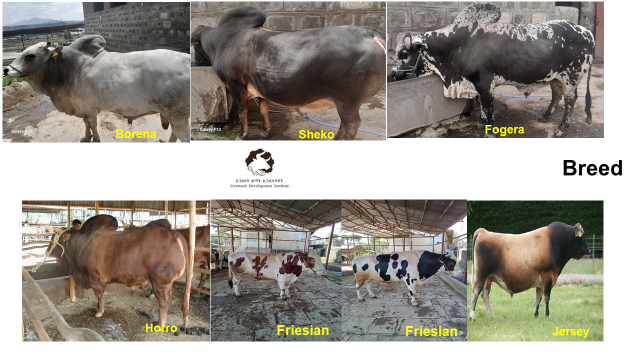
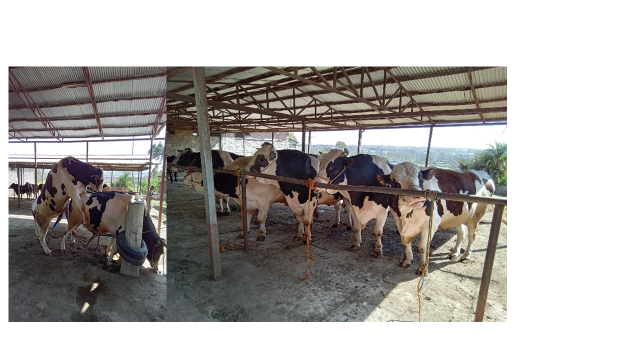
- Bull Nucleus Herd Management: LDI maintains a carefully curated nucleus herd of elite breeding bulls at HLDC. Bulls are selected from both imported pure breeds (Holstein Friesian, Jersey, Simmental, and others) and the best-performing locally adapted crosses, based on estimated breeding values (EBVs), conformation, health status, and reproductive performance.
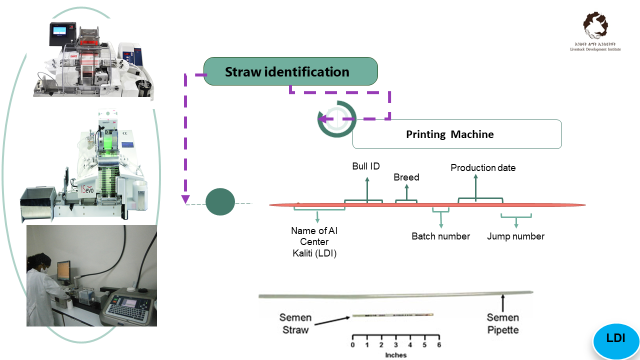
- Semen Production and Quality Control: The LDI semen processing laboratory operates at international standards, producing hundreds of thousands of semen straws per production cycle. Every batch undergoes rigorous quality testing, including progressive motility assessment, morphological evaluation, viability testing, and microbiological screening, before being approved for distribution.
Strategic Cross-Breeding and Genetic Evaluation
Successful breed improvement in Ethiopia requires more than simply using foreign exotic breeds. Ethiopia’s diverse agro-ecological zones, from the cool, moist highlands to the hot, arid lowlands; impose very different demands on livestock. An animal bred for optimal performance in a European temperate environment will often fail in Ethiopian conditions, however high its milk production potential. The science of strategic cross-breeding addresses this challenge by blending the hardiness and adaptability of indigenous Ethiopian breeds with the productive potential of exotic or improved breeds, calibrated to the specific requirements of each agro-ecology and production system.
- Cross-Breeding Technical Manuals: In-depth, evidence-based practical guides for farmers, technicians, and extension workers covering: the science and principles of cross-breeding, proven cross-breeding strategies for highland, midland, and lowland agro-ecologies, recommended breed combinations for dairy, beef, dual-purpose, and fiber production systems, case studies from successful cross-breeding programs in Ethiopia and comparable countries, and step-by-step guidance for implementing a systematic cross-breeding program on farm.
- Performance Recording System: LDI operates and supports a national livestock performance recording system enabling farmers, cooperatives, and commercial producers to track key production indicators — including daily milk yield, cumulative lactation yield, calving interval, service rate, conception rate, growth rate (live weight), carcass yield, egg production, and disease incidence. Performance data collected through this system feeds into LDI’s national genetic database and is used to generate estimated breeding values for bulls used in the AI program.
- Breed Evaluation Trial Results: LDI publishes the results of ongoing and completed breed evaluation trials in accessible formats; showing clearly which breeds and cross-breed combinations perform best under which management conditions. These results help farmers and investors make evidence-based decisions about which genetics to use for their specific production goals and agro-ecological context.
- Custom Breeding Program Design: For larger investors and commercial producers, LDI’s specialist team provides bespoke breeding program design services, developing a comprehensive, science-based breeding strategy tailored to the investor’s production goals, market targets, agro-ecological context, and capital budget.
Indigenous Breed Conservation and Promotion
Ethiopia is one of the world’s most important centers of livestock genetic diversity. Over thousands of years of co-evolution with Ethiopia’s highly variable environment, unique indigenous breeds of cattle, sheep, goats, chickens, camels, and equines have developed remarkable adaptive traits; including tolerance to drought, resistance to endemic diseases such as trypanosomiasis, ability to thrive on poor-quality forage, and resilience to extreme temperature fluctuations. These traits represent irreplaceable genetic resources whose global value — particularly in the context of accelerating climate change — continues to grow.
- Ethiopian Indigenous Breed Database: A comprehensive, publicly accessible digital portal featuring detailed profiles of every identified indigenous livestock breed in Ethiopia. Each breed profile includes: common and scientific name, geographic distribution and population estimate, physical description and breed characteristics, production traits (milk yield, growth rate, drought tolerance, disease resistance), cultural and economic significance to local communities, conservation status and threat assessment, and references to published research. The database is searchable by species, region, trait, and production system.
- Community-Based Conservation Programs: LDI works in partnership with local communities, pastoral associations, and regional governments to implement in-situ conservation strategies that keep indigenous breeds thriving in their natural environments while generating tangible benefits for the people who maintain them. Programs include community breeding group establishment, performance recording systems adapted for pastoral contexts, linkage to niche markets that reward indigenous breed quality, and financial and technical support for community gene banks.
- Sustainable Utilization Guidelines: Practical manuals and advisory support for producers seeking to commercialize indigenous breeds in ways that create economic value while maintaining genetic integrity. This includes guidance on accessing niche markets (organic, specialty meat, artisanal dairy, high-quality fiber), marketing indigenous breed products (labeling, branding, certification), and balancing genetic improvement with conservation of adaptive traits.
- Photo and Video Gallery: A rich multimedia archive celebrating the beauty, diversity, and cultural significance of Ethiopia’s indigenous livestock — serving as both an educational resource and a promotional tool for niche market development.
Quality Assurance and Research Support
LDI’s breed improvement services are underpinned by rigorous quality assurance systems and a continuous commitment to research-driven improvement. Quality control laboratories at HLDC test every dose of semen and batch of genetic material against international standards for motility, viability, morphology, and freedom from contamination before approving it for distribution. LDI also invests in the next generation of livestock scientists through structured visitor programs, summer student attachments, graduate thesis supervision, and postdoctoral research fellowships.